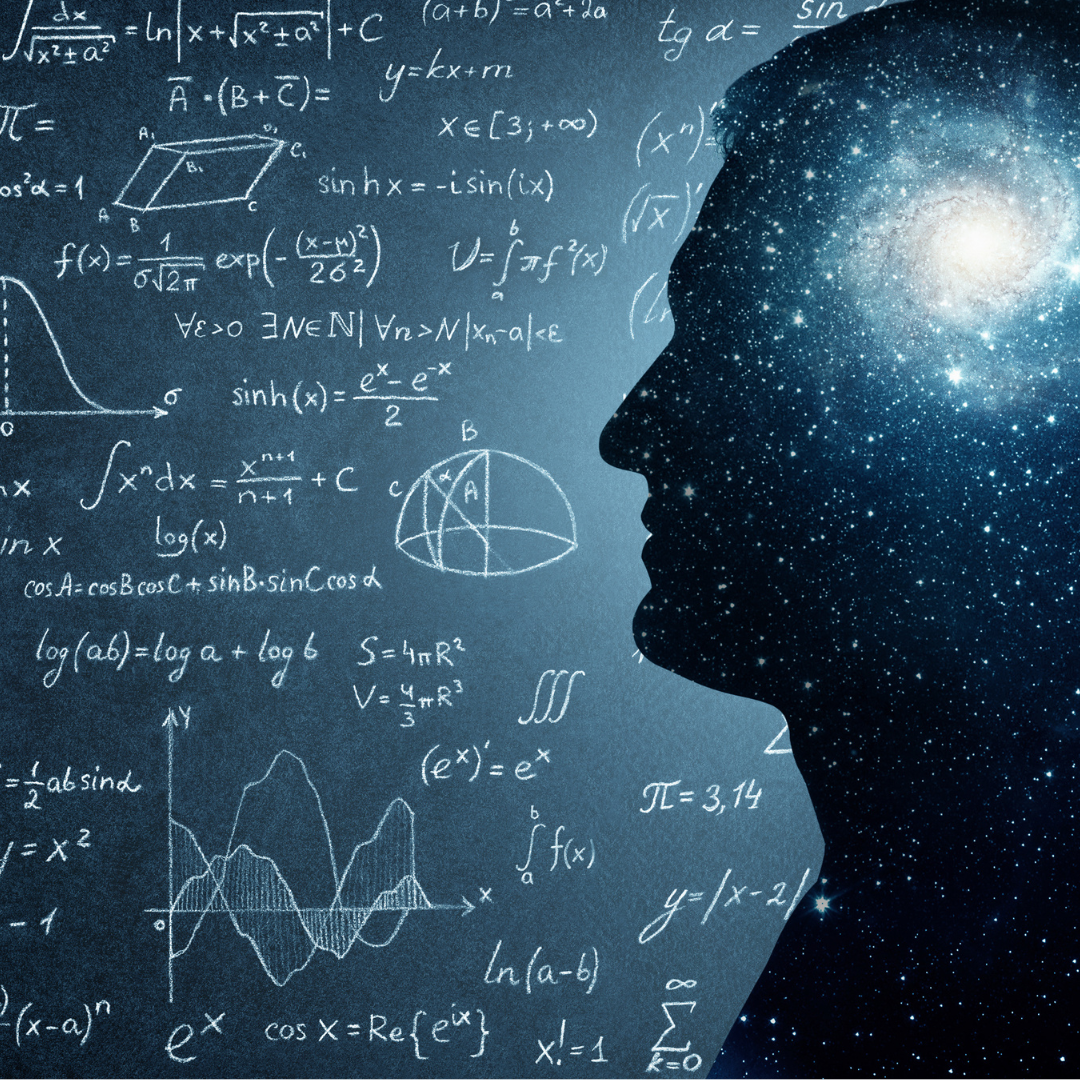
Mathematics and philosophy are two disciplines that seem different on the surface, but they have a lot of fundamental similarities in terms of methods, goals and principles. Both involve logical reasoning, abstraction, and the search for universal truth. In this article, we'll explore the relationship between mathematics and philosophy, as well as how these two disciplines affect each other in history and intellectual development.
Relationship Between Math and Philosophy
Mathematics is often considered as an exact science, where truth can be proven firmly through formal evidence. Meanwhile, philosophy learns big questions about existence, knowledge, ethics and logic. Both share an approach in using logic to achieve a deeper understanding of reality and the world.
- Logic and ExpositionPhilosophy and mathematics both rely heavily on logic. Formal logic, developed by philosophers like Aristotle, forms the basis of many principles in mathematics. Many mathematical branches, such as the theory of set, number theory, and geometry, depend on the principles of logic to build a consistent system.
- Abstraction: One of the major mathematical traits is the ability to specialize concept- concept concrete into a more common form. For example, numbers, which at first might represent physical objects, can be raised into abstract concepts in numbers. Philosophy also functions in the same way, by raising problems of everyday life into deep questions about reality and knowledge. Plato, an ancient Greek philosopher, even believed that the real world was a shadow of an ideal world that can only be understood through mathematics and philosophy.
- Mathematical EpistemologyEpistemology is a branch of philosophy that learns how we know what we know. In the mathematical context, epistemology asked about the nature of mathematical knowledge itself. Are the numbers and concepts of mathematics "exist" in real life, or is it just our mental construction? Questions like this have been disputed by philosophers for centuries.
Mathematical Philosophy
Mathematical philosophy is a branch of philosophy that specifically studies conceptual foundations and philosophy behind mathematics. Some topics learned in mathematical philosophy among others:
- Mathematical PlatonismPlatonism, named after the philosopher Plato, is the view that mathematical objects, such as numbers and geometric shapes, exist outside the physical world and are an independent abstract entity of the human mind. In this view, mathematics is discovery, not creation. Mathematicians invented facts about this abstract world, like an explorer who discovered a new island.
- FormalismoFormalism is a view that states that mathematics is just a game of symbols without intrinsic significance. In this view, mathematics is a series of formal rules followed by manipulating symbols without needing more philosophical interpretation of the meaning of the symbols. The main character who supports this view is David Hilbert.
- LogismLogism is the view that all mathematics can be reduced into logic. Bertrand Russell and Alfred North Whitehead tried to prove this in their masterpiece, Mathematica Principia, where they try to show that other arithmetic and mathematics can come entirely from the principles of logic.
- ConstructionConstructivism in mathematical philosophy emphasizes that mathematics only exists when we can build it explicitly. Mathematicians like L.E.J. Brouwer argued that mathematics was not an abstract external world discovery, but something created by the human mind.
Philosophy of Modern Mathematics
Throughout history, philosophy has played a crucial role in forming our understanding of mathematics. One of the most important moments in mathematical history is the development of non-Euclidean geometry in the 19th century, which radically challenged geometric assumptions that have been accepted over 2,000 years. The philosophical thinking of space and time and reality helps facilitate this progress.
Other characters like Kurt Gödel, who worked in the 20th century, also affected mathematics with evidence of Gödel's incompleteness theorem, which states that in a fairly powerful mathematical system, it is impossible to prove that the system is consistent. It brings great implications not only to mathematics, but also to philosophy knowledge and logic.
Conclusion
Mathematics and philosophy, although it is often considered to be a separate discipline, have a very close relationship. Both using logic and abstraction to answer fundamental questions about reality, knowledge and truth. From Platonism to modern logic theory, philosophy has been formed and influenced by mathematical development throughout history. The understanding of these two disciplines not only extends intellectual insight, but also helps us understand more deeply about the world around us.
source: Russell, B. & Whitehead, A. N. Cambridge University Press.